
Usted está aquí
Peruvian Journal of Neurosurgery
Primary amoebic meningoencephalitis due to Naegleria fowleri: case report.
GABRIEL PONCE M., ALEJANDRA VASQUEZ B., IVAN ANDÍA R., GUINEZ MUÑUICO M., ASTRID CARRIÓN C., RUBÍ ALANYA Y.
Abstract (Spanish) ||
Full Text ||
PDF (Spanish)
ABSTRACT
|
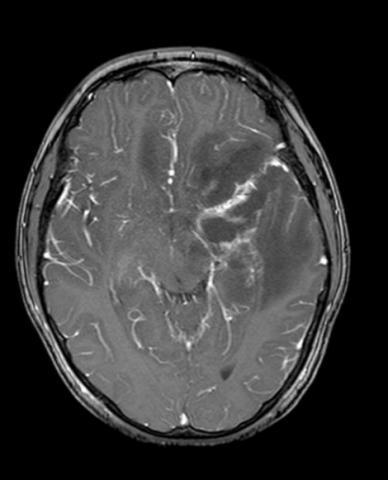
Objective: Free-living amoeba infections present with acute intracranial hypertension that are difficult to manage. In Peru, the most reported species are Balamuthia spp., Acanthamoeba spp., and Naegleria spp. We present the case of a child with a torpidly progressing amoebic meningoencephalitis, seen in our hospital in May 2023. Our objective is to describe the aggressive clinical presentation as a differential diagnosis for a brain tumor. Clinical case: A 9-year-old male patient from rural northern Peru with a history of protein malnutrition presented with an initial clinical presentation of mild headache, progressive weakness in the right side of the body, subsequently progressing to severe headache, vomiting, and neurological deterioration. Examination revealed drowsiness, global aphasia, right hemiplegia, and left ptosis. Three surgeries were performed in two stages: First, a left frontotemporal craniotomy and partial excision of a poorly defined, yellowish lesion attached to the neurovascular structures of the Sylvian valley; second, a left decompressive craniotomy and external ventricular drainage for severe intracranial hypertension. Conclusion: Treatment of cerebral amebiasis should be multidisciplinary. Early initiation of specific drugs is crucial to reduce mortality and complement surgical and intensive care treatment, given the aggressive nature of the infection. Keywords: Amebiasis, Amoeba, Naegleria, Intracranial Hypertension, Hemiplegia. (Source: MeSH NLM)
|